Mathematics
Curriculum Intent
The mathematics curriculum at Blessed Robert Sutton Catholic Voluntary Academy is designed to ensure that all young learners not only achieve success during their time with us but are fully equipped to thrive in future academic pathways and employment. The curriculum has been deliberately structured to promote:
- Confidence, resilience and fluency in mathematical knowledge, enabling students to work with accuracy, efficiency and assurance.
- Mathematical skills to solve contextual problems, applying knowledge flexibly to real‑life and unfamiliar situations.
- Reasoning and understanding so students can tackle problems methodically, justify their thinking and make connections across mathematical ideas.
- Independent and collaborative learning, developing the ability to work autonomously while also engaging productively with others.
- Enthusiasm for mathematics and an appreciation of the wide range of careers and opportunities it supports.
Mathematics will teach spiritual development by supporting students to make sense of the world around them and explore the deep connections between their numeracy skills and everyday life. Through mathematical thinking, learners develop an appreciation of pattern, order and structure, gaining insight into how the world is shaped, measured and understood. They learn to reflect, question and seek meaning, recognising that mathematics reveals beauty, coherence and purpose in creation.
- Making sense of the world — understanding how mathematical ideas underpin daily life, nature and human activity.
- Exploring connections — seeing relationships between concepts, patterns and structures.
- Reflective thinking — developing curiosity, insight and thoughtful engagement with problems.
- Appreciation of order and pattern — recognising the elegance and coherence within mathematics.
Mathematics will teach social excellence through a range of teaching strategies that enable pupils to work effectively as a community. Structured class discussions and opportunities to explore different approaches to a problem help pupils develop the skills needed to collaborate successfully — communicating clearly, respecting others, listening actively, and building on each other’s ideas. Through shared problem‑solving, students learn to value diverse perspectives, support one another, and contribute positively to group learning.
- Collaborative problem‑solving — working together to explore strategies and refine solutions
- Communication in mathematics — expressing ideas clearly and precisely
- Respectful dialogue — listening, questioning and responding thoughtfully
- Community learning — recognising the value of shared understanding
Mathematics will teach academic excellence by developing pupils’ ability to think creatively, act independently, and demonstrate the resilience required to solve complex problems. Teaching is centred on building a strong conceptual understanding of the underpinning principles of mathematics, ensuring students grasp not only how methods work but why they work.
These principles are strengthened through the consolidation of key topics, with continual extension and challenge to stretch all learners. We aim to foster confidence, enjoyment, and a secure foundation for future study, while providing sustained challenge that stretches even the most able mathematicians. To ensure students can link their studies to the real world, mathematical topics are connected with applied contexts and additional material designed to broaden interest and demonstrate how mathematics shapes everyday life, scientific understanding, technology, and future careers.
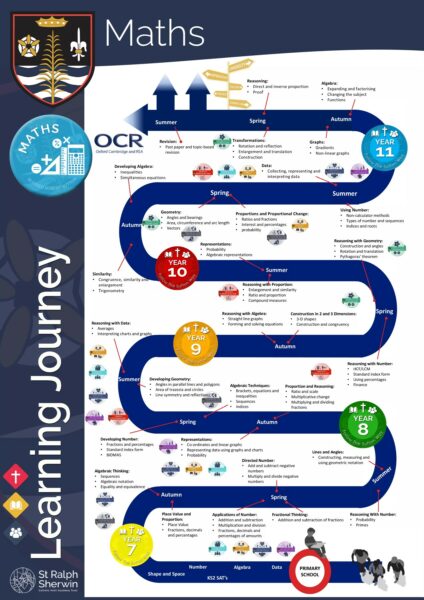
Maths Learning Journey
Useful Documents
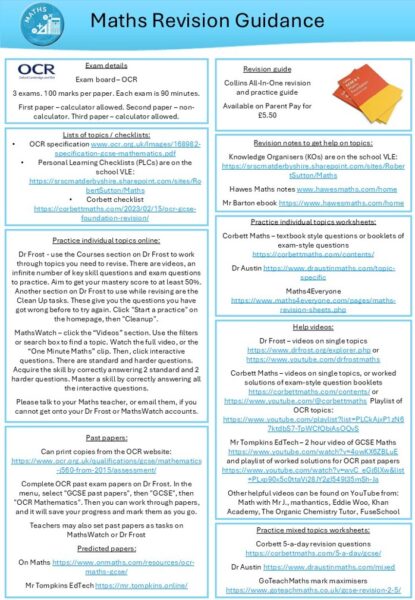
Maths Revision Tips
Click on the image below to open the document